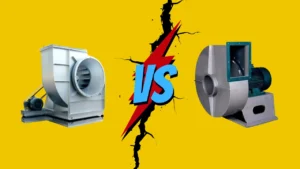
In many industrial plants such as boilers, power plants, cement units, and process industries, proper air movement is essential for safe and efficient operation. One important component used for this purpose is the ID Fan, also known as the Induced Draft Fan. Understanding the ID fan working principle helps in knowing how it maintains smooth airflow and pressure balance in industrial systems.
What is an ID Fan?
An ID Fan (Induced Draft Fan) is a mechanical fan installed at the outlet of a boiler, furnace, or process system. Its main function is to pull flue gases, smoke, and hot air out of the system and release them through the chimney or stack. By doing this, the ID fan maintains negative pressure inside the furnace or boiler.
Working Principle of ID Fan
The ID fan works on the principle of induced suction and pressure difference. The complete operation can be understood step by step:
1. Combustion and Flue Gas Generation
Inside the furnace or boiler, fuel combustion generates hot gases, smoke, ash particles, and other by-products. These gases must be continuously removed to avoid pressure buildup and ensure smooth combustion.
2. Creation of Negative Pressure
When the ID fan starts operating, its rotating impeller creates a low-pressure (negative pressure) zone at the furnace outlet. This negative pressure is essential to:
- Prevent flue gas leakage
- Maintain stable flame conditions
- Ensure operator safety
3. Suction of Flue Gases
Due to the pressure difference between the furnace and the fan inlet, flue gases are drawn from the combustion chamber. The gases pass through:
- Heat exchangers (economizer, air preheater)
- Dust collectors or ESP systems
- Ducting network
4. Impeller Action and Gas Acceleration
The ID fan impeller rotates at high speed, converting mechanical energy from the motor into kinetic energy. This action:
- Accelerates the flue gases
- Increases their velocity
- Directs them towards the fan outlet
5. Discharge Through Chimney
After passing through the fan, the gases are discharged through the chimney or stack at a controlled flow rate. This ensures:
- Safe release of exhaust gases
- Compliance with environmental norms
- Continuous system operation
6. Airflow Balance with FD Fan
In most boiler systems, the ID fan works in coordination with the FD (Forced Draft) Fan. While the FD fan supplies fresh air for combustion, the ID fan removes exhaust gases, maintaining a balanced airflow and stable furnace pressure.
ID Fan in Boiler
An Induced Draft Fan (ID Fan) is installed at the outlet of the boiler, near the chimney. Its main function is to suck flue gases, smoke, and hot air out of the boiler and discharge them through the stack. By doing this, the ID fan maintains negative pressure inside the furnace, which helps in stable combustion, prevents gas leakage, and improves overall boiler efficiency.
In power plants, the ID fan works together with the FD (Forced Draft) Fan to balance airflow—FD fan supplies fresh air for combustion, while the ID fan removes exhaust gases safely.
Importance of Efficient ID Fan Design
A poorly designed ID fan can lead to energy loss, unstable combustion, and increased emissions. That’s why industries rely on experienced manufacturers for reliable solutions.
We design and manufacture high-performance ID fans with precision-balanced impellers, strong casings, and efficient airflow design. Our fans are built to handle high temperatures, dust-laden gases, and continuous industrial operation.
Advantages of ID Fans
- Stable negative pressure control
- High efficiency and energy savings
- Heavy-duty construction
- Low vibration and noise levels
- Long service life with minimal maintenance
Conclusion
The ID fan working principle is based on creating controlled suction to remove flue gases and maintain negative pressure inside industrial systems. From combustion gas extraction to chimney discharge, every step ensures safe, efficient, and compliant plant operation. With reliable solutions from Refcon Engineering, industries can achieve smooth airflow management and dependable performance.