If you work in the building services or HVAC industry, you’ve probably come across the terms AHU and HVAC quite often. Many people use them interchangeably, which leads to confusion — but are they actually the same? Not exactly. While they are closely connected, each plays a unique role in managing indoor air quality and comfort.
An Air Handling Unit (AHU) is a key component within a larger Heating, Ventilation, and Air Conditioning (HVAC) system. This is where the confusion usually begins. The AHU’s primary job is to circulate and condition air, whereas an HVAC system is a much broader setup responsible for heating, cooling, ventilation, and sometimes humidity control across an entire building.
Because the AHU forms the “lungs” of the HVAC system, there is definitely some functional overlap. However, they are not interchangeable terms. HVAC refers to the entire climate-control infrastructure, while the AHU is just one — albeit essential — part of that complete system.
What Is an HVAC System?
An HVAC system, which stands for Heating, Ventilation, and Air Conditioning, is an essential setup used in residential, commercial, and industrial buildings to maintain indoor comfort. HVAC systems regulate temperature, control humidity, and ensure proper air circulation throughout the space. Whether it’s a home, office, hospital, hotel, or manufacturing unit, HVAC systems play a key role in creating a healthy and comfortable indoor environment.
Modern HVAC systems are designed to be energy-efficient, cost-effective, and environmentally friendly. They help reduce energy consumption while maintaining optimum indoor conditions, making them essential for modern infrastructure. Whether in small buildings or large industrial complexes, HVAC systems ensure a balanced environment where people can work, live, and breathe comfortably.
AHU (Air Handling Unit)
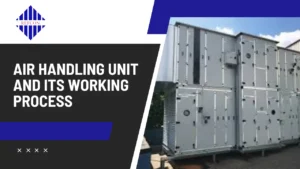
The primary purpose of an AHU (Air Handling Unit) is to ensure better indoor air quality by efficiently circulating, filtering, and conditioning the air inside a building. An AHU forms a crucial part of the HVAC system and is responsible for maintaining a clean, comfortable, and healthy environment. Installed typically in a dedicated space called the AHU Room (AHU room full form: Air Handling Unit Room), it houses all components required for air treatment.
An AHU is made up of several integrated parts, each performing a specific function to condition the air. Depending on the building’s requirement, an AHU may include a combination of the following components:
- Mixing Chamber – Blends fresh outdoor air with return air from the building to maintain air balance.
- Filters – Remove dust, allergens, and particles to deliver clean and healthy air.
- Cooling Coil / Heating Coil – Conditions the air by cooling or heating it based on the temperature requirement.
- Blower / Fan – Circulates air through the ducting system across various zones of the building.
- Humidifier / Dehumidifier – Controls moisture levels to maintain comfortable indoor humidity.
- Dampers – Manage airflow direction to ensure proper distribution and pressure control.
- Casing / Insulation – Prevents heat loss, noise, and leakage for efficient performance.
Air Filter
Air filters are essential components used in AHU and HVAC, air purifiers, and industrial ventilation units to maintain clean, healthy indoor air. Their primary function is to capture dust, allergens, pollutants, microorganisms, and other airborne particles before the air circulates into occupied spaces. By improving air quality, air filters help protect both human health and equipment performance.
Air filters are typically made of fiberglass, synthetic fibers, pleated materials, or HEPA-grade media depending on the application. As air passes through the filter, contaminants get trapped in the filter media while only clean air moves forward. This filtration process reduces respiratory issues, prevents dust accumulation on coils, and increases the overall efficiency of HVAC systems.
There are different types of air filters such as pre-filters, fine filters, HEPA filters, activated carbon filters, and bag filters, each designed to remove particles of specific sizes. HEPA filters, for example, can remove up to 99.97% of microscopic particles, making them ideal for hospitals and clean rooms.
Energy Recovery Component
Energy recovery components are a vital part of modern HVAC and AHU systems by improving energy efficiency and reducing overall operating costs. These components are designed to capture thermal energy from exhaust air and transfer it to incoming fresh air without mixing the two streams.
The most common energy recovery components include Energy Recovery Wheels (ERW), also known as enthalpy wheels, Heat Recovery Wheels, Plate Heat Exchangers, and Run-around Coil Systems. Each of these mechanisms works by extracting heat or moisture from the outgoing air and reusing it during the ventilation process.
For example, an energy recovery wheel rotates between supply and exhaust air sections, transferring heat and humidity efficiently. Plate heat exchangers transfer temperature energy through thin plates without allowing air streams to mix. Run-around coils use circulating glycol/water solutions to recover heat between separated air streams.
Energy Efficiency and Modern AHUs
New-generation AHUs are developed to reduce energy consumption. Features include:
- EC or VFD fans
- HEPA or ULPA filters
- Energy recovery systems
- Smart sensors
- Thermal break construction
- Low leakage panels
Heating and Cooling Components
Heating and cooling components are core elements of any AHU and HVAC setup. Their primary function is to condition the air to the desired temperature, ensuring indoor comfort throughout the year. These components work together to either raise the air temperature during cold weather or lower it during hot conditions, making them essential for climate control in commercial, industrial, and residential buildings.
Heating Components
Heating in an AHU is typically achieved using:
- Heating Coils (Hot Water Coils / Steam Coils) – Transfer heat from hot water or steam to the air passing over them.
- Electric Heaters – Use electric resistance to generate heat, ideal for precise temperature control.
- Heat Pumps – Reverse refrigeration cycles to provide energy-efficient heating.
Cooling Components
Cooling is accomplished through:
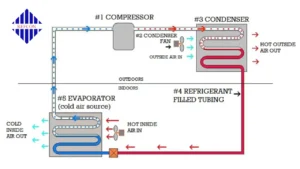
- Cooling Coils (Chilled Water Coils / DX Coils) – Absorb heat from the air as chilled water or refrigerant flows through the coil.
- Refrigeration Units (DX Systems) – Use refrigerant circuits to cool air directly inside the unit.
- Evaporative Cooling Modules – Use water evaporation to naturally reduce air temperature.
Together, these components ensure consistent temperature regulation, thermal comfort, and efficient HVAC performance. They also help maintain proper humidity levels, contributing to improved indoor air quality and energy savings.
Difference Between AHU and HVAC
People often confuse AHU and HVAC, but the two are not the same. Think of an HVAC system as the entire body, while the AHU is just one important organ inside that body.
HVAC – The Complete System
The term HVAC stands for Heating, Ventilation, and Air Conditioning. It includes everything used to control indoor climate—chillers, boilers, ductwork, compressors, fans, control systems, and the AHU itself. Its job is to heat, cool, ventilate, and maintain air quality across an entire building.
AHU – Component Inside HVAC
An AHU (Air Handling Unit) is one functional unit within the HVAC system. It does not create cooling or heating on its own. Instead, it handles the air—filtering it, mixing it, humidifying or dehumidifying it, and then pushing it into the duct network.
The AHU relies on chilled water, hot water, or refrigerant supplied by other HVAC equipment.
In Simple Terms
- HVAC = The full climate-control system.
- AHU = The device that conditions and circulates air inside that system.
Difference at a Glance
- HVAC is the overall infrastructure.
- AHU is a part of that infrastructure.
- HVAC generates heating/cooling; AHU distributes treated air.
- HVAC spans the whole building; AHU stays in mechanical rooms or rooftops.